
The History of Chikankari: From Lucknow to Pakistani Wardrobes
Chikankari is a hand embroidery that comes from Lucknow, India. Most accounts trace it back to the Mughal court of the 17th century, and the popular story gives the credit to Empress Noor Jahan. It really came into its own under the Nawabs of Awadh, and after Partition in 1947 it became part of Pakistani wardrobes too. Today you'll mostly see it on light lawn and cotton suits.
If you've ever held a chikankari kurta up to the light, you'll know why people fall for it. White thread on white cloth, and somehow the whole thing seems to glow. The history of chikankari is a story about one needle, one city and a few hundred years of women's handwork, and it ends up in the lawn suits and festive sets we wear from Eid to wedding season. So where did it start, and how did it get here?
Chikankari at a Glance
| Question | Short answer |
|---|---|
| What is it? | A traditional hand embroidery, historically a type of whitework |
| Where is it from? | Lucknow, Uttar Pradesh, India |
| Traditional look | White thread on white or pale muslin and cotton |
| Popular origin story | Empress Noor Jahan, wife of Emperor Jahangir (early 17th century) |
| Golden age | The Nawabs of Awadh, 18th to mid-19th century |
| Number of stitches | Usually cited as 32 to 36 or more (counts vary by source) |
| Legal recognition | "Lucknow Chikankari" received Geographical Indication (GI) status in December 2008 |
| Who makes it | Mostly women artisans, many working from home |
| In Pakistan today | Worn widely on lawn, cotton and other fabrics, in white and in colour |
What Is Chikankari?
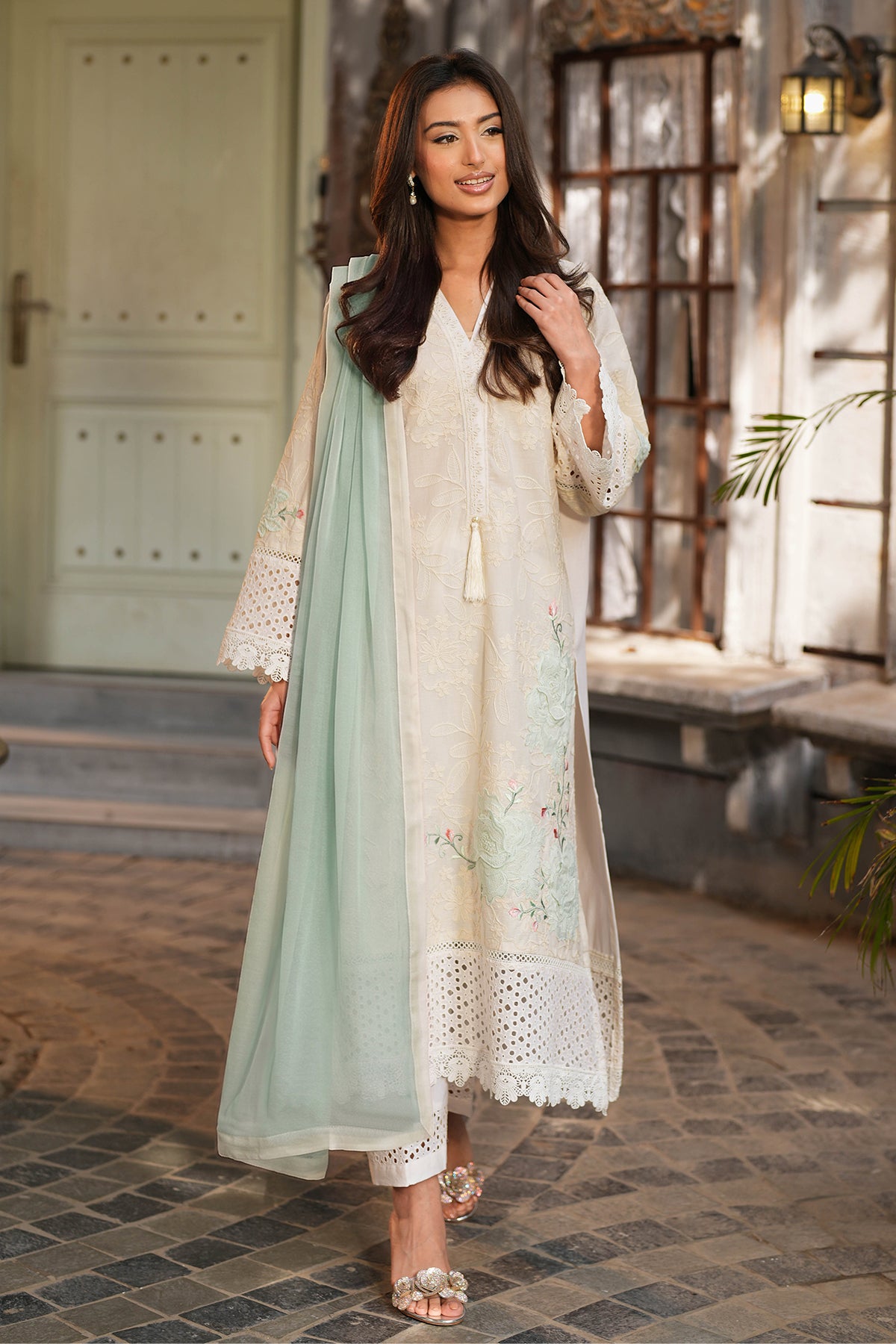
Chikankari (Urdu: چکن کاری) is a style of hand embroidery where fine stitches are worked onto lightweight fabric to make floral and lattice-like patterns. It started out as white-on-white work, so the beauty comes from texture and light rather than colour. Some stitches lie flat. Some form tiny raised knots. Others gently pull the threads of the cloth apart to leave little mesh windows.
These days the word covers a whole family of clothes, from classic white kurtas to coloured lawn suits and organza festive wear.
Where Did Chikankari Come From?
The story most people tell credits Noor Jahan, the Mughal empress and wife of Jahangir, with bringing chikankari to India in the early 17th century. She was known for her taste, and in this version she knew Persian needlework and passed it on to the women of the court. Other accounts point more broadly to Persian or even Turkish embroidery as an influence.
Here's the honest bit: historians haven't settled on one documented origin. The Noor Jahan story is a tradition people have repeated for generations, not a proven fact. What we can say is that the motifs fit Mughal taste, with flowers, vines and lattice patterns that echo Mughal architecture, and that the craft became closely tied to the courts of northern India.
How Did Lucknow Become the Home of Chikankari?
As Mughal power faded in the 18th century, the Nawabs of Awadh turned Lucknow into one of the great centres of art, food, poetry and textiles on the subcontinent. Fine embroidered cloth suited both the climate and the court's love of refinement, and the Nawabs' patronage gave artisans steady work and real prestige. Textile historians note that the layered court dress of the time, including the long choga, was often chikan-embroidered.
Lucknow's Chowk market is still the best-known place to buy chikan, and the city's name stuck to the craft so firmly that "Lucknowi chikankari" is still the term for the original.
What Happened After the Nawabs?
The British annexed Awadh in 1856, and the court patronage that had supported so many artisans dried up. Chikankari survived because it was woven into everyday life: women in Lucknow and the villages around it kept stitching at home. Descriptions of the craft's workforce say it's mostly Muslim and overwhelmingly female.
In the 1980s, organised revival efforts began promoting chikankari among women artisans as a way to earn an income. Then in December 2008, "Lucknow Chikankari" received Geographical Indication (GI) status, which formally recognises Lucknow and the area around it as the craft's home.
Chikankari Timeline
| Period | What happened |
|---|---|
| Early 17th century | Popular tradition links Empress Noor Jahan to the craft's arrival (not firmly documented) |
| 18th century | Nawabs of Awadh make Lucknow a cultural capital, and chikankari flourishes under their patronage |
| 1856 | Awadh is annexed by the British and court patronage declines |
| 1947 | Partition moves millions of people, and Urdu-speaking communities from northern India resettle in Pakistan, especially Karachi |
| 1980s | Early organised revival efforts among women artisans in Lucknow |
| 2008 | "Lucknow Chikankari" receives GI status (December) |
| 2020s | Pakistani and Indian labels reinterpret chikankari on lawn, organza and georgette, in colour |
How Is Chikankari Made?
The traditional process has three broad stages:
- Block printing. A design is stamped onto the fabric using carved wooden blocks and a washable blue ink.
- Embroidery. Artisans stitch over the printed outline, and different specialists often handle different stitches.
- Washing and finishing. The ink is washed out and the piece is finished, leaving the pattern in thread alone.
The Stitches That Define Chikankari
| Stitch | What it looks like |
|---|---|
| Bakhiya (shadow work) | Worked on the reverse, so a soft, shadowy outline shows through sheer fabric |
| Murri | Small, grain-like stitches, often described as the oldest and most prized |
| Jaali | A mesh effect made by gently pulling the fabric's threads apart |
| Phanda | Tiny raised knots that look like grains of millet |
| Tepchi | Long running stitches that outline the motifs |
Curious how to spot these on a real piece? Our guide on how to identify original handcrafted chikankari suits walks through the reverse-side test and what to look for in the stitching.
How Did Chikankari Reach Pakistani Wardrobes?
Partition set more than 15 million people in motion, and they carried their trades, food, language and clothes with them. Karachi's population alone grew by roughly 115% in the years that followed, with large communities arriving from across northern India, including the old Awadh region. Chikankari's look, long tied to Urdu-speaking culture, travelled with them.
One caution: detailed records of how individual chikan artisan families resettled in Pakistan are thin, so be wary of anyone who claims to know exact lineages. What we can say confidently is that chikankari is now a fully established part of Pakistani fashion. It's especially popular in summer, when light embroidery on lawn and cotton suits Pakistan's lawn season perfectly. It also turns up at celebrations, and our guide to chikankari suit trends for winter weddings 2026 shows how it's styled for mehndi, barat and walima.
Lucknowi Chikankari vs Pakistani Chikankari
| Aspect | Lucknowi chikankari | Pakistani chikankari |
|---|---|---|
| Craft's home | Lucknow and surrounding districts, India | Made and sold across Pakistan, drawing on the same stitch tradition |
| Name protection | "Lucknow Chikankari" carries GI status | Usually sold simply as chikankari or chikan work |
| Typical fabrics | Muslin, cotton, mulmul, voile, chiffon, georgette, organza | Often lawn and cotton, plus silk and other festive fabrics |
| Typical colours | Traditionally white, now pastels and brights | Pastels and festive tones alongside classic whites |
| Typical use | Kurtas, sarees, festive wear | Lawn suits, 2 and 3 piece sets, festive wear |
Why It Still Matters
Chikankari is slow work. A single piece can take days or even weeks of hand embroidery, and most of the artisans behind it are women. Computerised machine copies exist and can look similar at a glance, but the motifs and finish are different once you know what to look for. Choosing hand-embroidered chikankari helps keep a living craft, and the incomes it supports, going.
That's the idea behind our Ruh chikankari lawn suits collection, which brings the tradition into modern wardrobes with designs named after flowers, like Cherry Blossom. If you're torn between embroidered and printed lawn for summer, we compared them in chikankari lawn suits vs printed lawn suits. And if you're wondering whether one chikan suit is really worth having, why every woman needs a chikankari suit makes the case.
FAQs About the History of Chikankari
What is chikankari? It's a traditional hand embroidery from Lucknow, India, known for fine white-on-white stitching that creates floral patterns and delicate mesh effects on lightweight fabric.
Who invented chikankari? Nobody knows for certain. The most popular tradition credits Empress Noor Jahan, wife of Emperor Jahangir, with introducing it in the early 17th century, but historians treat that as an origin story rather than proven fact.
Where did chikankari originate? In Lucknow, Uttar Pradesh, India. Its roots are linked to the Mughal court, and the Nawabs of Awadh nurtured it into the craft Lucknow is famous for.
How old is chikankari? About four centuries by the most common account, going back to the 17th-century Mughal court. Some sources suggest earlier roots, but firm documentation is limited.
Why is Lucknow famous for chikankari? The Nawabs of Awadh patronised the craft in the 18th and 19th centuries, and Lucknow's artisans and markets, like Chowk, built a lasting reputation. Lucknow chikankari received GI status in December 2008.
Is chikankari from India or Pakistan? The craft began in Lucknow, India. It's part of a shared subcontinental heritage and is now widely made, sold and worn in Pakistan, especially on lawn and cotton.
What does the GI tag on chikankari mean? A Geographical Indication tag recognises that a product's quality and reputation come from a specific region. For Lucknow Chikankari, it recognises Lucknow and the surrounding area as the craft's home.
How many stitches are there in chikankari? Sources usually say 32 to 36 or more. Well-known ones include bakhiya (shadow work), murri, jaali, phanda and tepchi.
Why was chikankari traditionally white? It grew out of white-on-white whitework on fine muslin, which suits hot climates well. Pastels and brighter colours came later.
Is chikankari the same as Lucknowi work? Lucknowi chikankari is the original, made in and around Lucknow. "Chikankari" is the wider term for the style, which is now produced in many places.
How can I tell hand-embroidered chikankari from machine embroidery? Hand work has small variations in the stitches and visible thread knots on the reverse, while machine work looks uniform. Our guide to identifying handcrafted chikankari suits explains the checks step by step.
چکن کاری کی تاریخ کیا ہے؟ چکن کاری لکھنؤ کی ہاتھ کی کڑھائی کی ایک روایت ہے۔ اس کی ابتدا عموماً مغل دور سے جوڑی جاتی ہے اور اودھ کے نوابوں کے دور میں اسے عروج ملا۔ تقسیمِ ہند کے بعد یہ پاکستانی ملبوسات کا بھی اہم حصہ بن گئی۔
Sources and Further Reading
- All India Artisans and Craftworkers Association (AIACA), Chikankari craft profile: https://www.aiacaonline.org/craftkatha-pop-up/chikankari
- The Lucknow Observer, "Timeless, Classic: That's Chikan Embroidery of Lucknow": https://lucknowobserver.com/?p=2565
- T2 Online (The Telegraph), session with Malavika Neogi Chatterjee on Lucknowi chikankari: https://t2online.in/events/events-1/t2online-gets-you-glimpses-from-byloom-s-special-session-on-lucknowi-chikankari-with-malavika-neogi-chatterjee/615797
- Arab News, on Partition migration and family trades: https://www.arabnews.pk/pakistan/in-karachi-a-familys-indian-sweet-recipe-survives-as-ties-across-the-border-fade-3002167
Explore more styling and craft guides on the Mariam Aziz blog, or shop the Ruh chikankari edit.
